
What Affects Your AC Installation Cost?
Let's break down what affects the cost.
The Size of the System
This is the biggest factor. An AC unit gets measured in tons. That has nothing to do with weight. It refers to cooling capacity. A small ranch home near Gravois Creek might need a 2-ton system. A larger two-story home closer to Highway 141 could need 4 tons or more.
Getting the size wrong causes real problems. We see this mistake all the time. A system that's too small runs nonstop and never cools your home. One that's too big cycles on and off too fast, it wears out sooner than it should. A proper load calculation is the only way to get this right.
Your Existing Ductwork
Here's something most people don't realize until it's too late. Your ducts matter as much as the unit. If your ductwork is old or undersized, a new AC system won't perform well. Air leaks through gaps and loose joints. That wastes energy and money every single month.
Some Fenton homes built in the 1970s and 1980s still have original ductwork. In those cases, HVAC duct and vent repair or even new HVAC duct and vent installation might be part of the project. That adds to the overall AC installation cost, but skipping it creates bigger headaches down the road.
Electrical and Code Requirements
Older homes sometimes need electrical panel upgrades. Your new AC system may draw more power than the old one. Local building codes in Fenton and St. Louis County also require permits for AC installation.
Permit fees and inspections add to the project scope. And if your home hasn't had a new system in 15 or 20 years, the refrigerant type has likely changed. Newer systems use R-410A or R-454B. Your old copper lines may not be compatible. That means new line sets running between the indoor and outdoor units.
Where the Equipment Goes
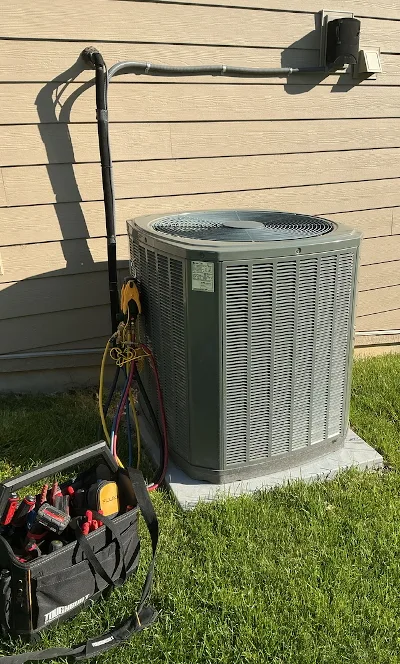
Location matters more than you'd think. Is the outdoor unit going on a concrete pad in a flat backyard? That's simple. Is it going on a rooftop or a tight side yard with barely two feet of clearance? That takes more time and labor.
The indoor equipment placement affects cost too. A furnace or air handler in an easy-access basement is one thing. One crammed into a small attic crawl space is another. We've done installs in Fenton homes where just getting the old equipment out took half a day.
The Type of System You Choose
A standard central AC system with ductwork is the most common setup. But some homes do better with a ductless AC installation. Older homes without existing ducts are a good example. A heat pump installation is another option that handles both heating and cooling in one unit.
The U.S. Department of Energy notes that heat pumps can cut electricity use for heating by about 65 percent compared to electric resistance heating. Each system type has different equipment and labor needs. That changes the AC installation cost.
So before you focus on a number, think about your home. Its age, its layout, its ductwork, its electrical setup. All of those things shape what your AC installation will involve. If you want a clear picture of what your specific home needs, our AC installation page walks you through the next steps.
Why Two AC Installation Quotes Can Look So Different
You get two quotes for AC installation. One is noticeably higher. That doesn't mean someone's trying to rip you off. It usually means the two companies are quoting different work.
We see this cause confusion all the time. A homeowner in Fenton calls us after getting a quote somewhere else, and the numbers don't match up. But once we walk through what's included in each quote, it starts to make sense.
Here's what makes one AC installation quote look different from another.
The Scope of Work Varies
One quote might cover just the outdoor unit swap. Another might include new ductwork, a thermostat installation, or an upgraded air handler. Same house, same need, very different jobs. The bigger scope costs more. That's not a red flag. It's just a more complete project.
Some quotes also include removing your old system. A/C system dismantlement takes labor and disposal fees. If one company leaves that out, their number looks lower on paper.
Equipment Size and Type
Not every contractor sizes the unit the same way. A proper load calculation looks at your home's square footage, insulation, window count, and layout. If one company skips that step, they might quote a smaller unit. Smaller unit means a lower price, but it won't cool your home right.
And the type of system matters too. A standard central AC unit costs less than a ductless AC installation or a heat pump installation. If one company recommends a heat pump because your home would benefit from it, that quote will be higher for a good reason.
What's Hiding in the Fine Print
Some quotes bundle everything together in one line. Others break it out. You want to know what you're paying for. Here are common items that may or may not be included.
- Permit fees required by the City of Fenton
- New refrigerant lines or electrical upgrades
- Thermostat installation or smart thermostat setup
- Disposal of the old AC system
- Post-install AC maintenance visit
If a quote seems low, check what's missing. A bare-bones number might leave you paying extra later for things the other company already included.
Labor and Installation Quality
This one's hard to see on paper. But it matters. A lot.
A crew that takes time to seal ductwork, check airflow, and test the system after install is doing a better job. That takes more hours. More hours cost more money. But you end up with an AC installation that runs right from day one.
We've gone behind other installs where the unit was technically running but pulling way too much energy. The ductwork connections were loose, the refrigerant charge was off. Data from the U.S. Department of Energy shows that improper installation can reduce AC efficiency (opens in a new tab) by up to 30 percent. That's real money on your electric bill every single month.
So when you're comparing quotes, don't just look at the bottom line. Ask what's included. Ask about the equipment size. Ask how long the install takes. A four-hour job and an eight-hour job are not the same job.
The right move is to get your quotes in writing and compare them side by side. If something's unclear, ask. A good contractor won't mind explaining every line. If you want help understanding what your home needs, our AC installation page walks through the process we use for every Fenton home we work on.
New AC Unit Cost vs. Full Installation: What's Included
A lot of folks in Fenton think AC installation cost just means the price of the unit itself. That's one of the biggest misunderstandings we run into. The equipment is only part of the picture.
The AC unit is the box that sits outside your home. It matters. But it's not the whole job.
A full AC installation includes the labor and materials needed to connect that unit to your home's existing ductwork and electrical system. It also covers the indoor components like the evaporator coil and sometimes a new air handler. Most homeowners don't realize how many separate pieces have to work together before cool air reaches your living room.
What a Full AC Installation Covers
Here's what's typically included when a licensed crew handles your AC installation in Fenton.
- Removing and disposing of your old outdoor unit and indoor coil
- Setting the new condenser on a proper pad outside your home
- Installing a matched indoor evaporator coil
- Running new refrigerant lines between indoor and outdoor components
- Connecting the system to your electrical panel
- Testing airflow through your existing ducts
- Performing a full charge and startup check
Every one of those steps takes time and skill. And skipping any of them can cause problems down the road. We've seen systems fail early because the refrigerant charge was off by just a small amount during setup.
The unit alone might account for roughly 50 to 60 percent of the total project cost, based on figures from Consumer Affairs (opens in a new tab). The rest goes toward labor, materials, permits, and the work that makes the system function in your home.
Why the "Unit Only" Number Is Misleading
People sometimes find a price for just the outdoor condenser online. They assume that's close to the final number. It's not.
Think about it this way. You wouldn't buy a car engine and expect it to drive itself home. The AC unit needs professional hands to make it part of your house. Refrigerant lines have to be brazed and pressure-tested. Electrical connections have to meet local code in Fenton and St. Louis County. The thermostat needs to communicate with the new system.
We've gotten calls from homeowners who bought a unit on their own, then couldn't find anyone willing to install it. That puts you in a tough spot.
One thing most people overlook is the indoor coil. Your new outdoor unit needs a matched coil inside. If the old coil doesn't match, your system won't run at its rated efficiency. You'll pay higher electric bills every single month. So that savings from buying the unit alone disappears fast.
Permits and Inspections Matter Too
In Fenton, AC installation work, even for a replacement, requires a permit. The city follows standard mechanical codes. An inspector will check the work after it's done. This protects you.
A proper AC installation includes pulling that permit and scheduling the inspection. Some companies skip this step to save time, that's a red flag. If the work isn't inspected, you have no proof it was done right. And it can cause problems if you sell your home later.
So when you're comparing numbers, make sure you're looking at the full AC installation cost. Not just the sticker on a box. The real investment includes everything it takes to get that system running safely and correctly in your home.
If you want a clear breakdown of what your specific AC installation would involve, our AC installation page walks you through the process step by step.